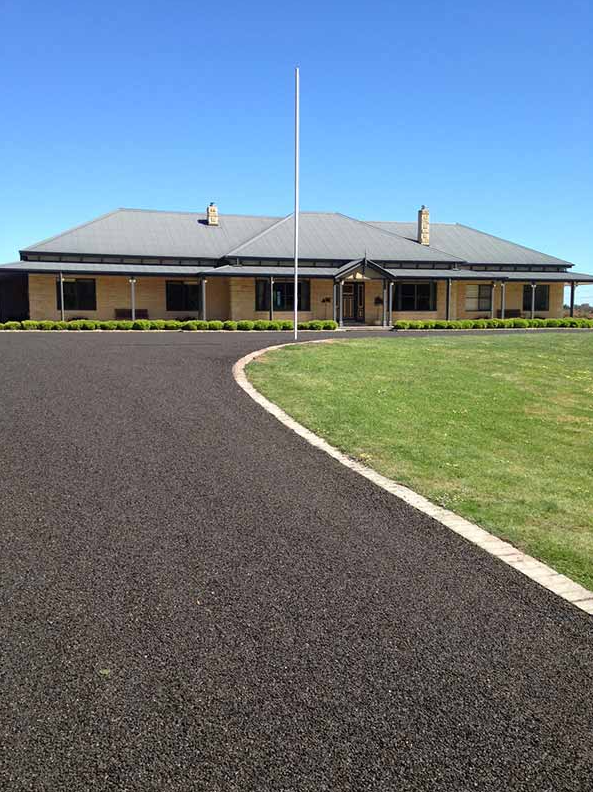
An asphalt entrance often experiences more concentrated wear than other parts of a driveway or access road. Vehicles repeatedly cross the same area, tyres turn as they enter and leave, and braking or acceleration can place additional stress on the surface. Over time, an entrance that was once smooth and well defined can become cracked, uneven, broken around the edges or affected by potholes.
The good news is that a badly worn asphalt entrance does not automatically need complete reconstruction. Depending on the condition of the pavement underneath, professional repairs or resurfacing may be able to restore its appearance, strength and functionality.
At Langwarrin Road Tech, we assess worn asphalt surfaces throughout Langwarrin, VIC to determine what has caused the deterioration and which restoration method is appropriate.
Why Do Asphalt Entrances Wear So Heavily?
An entrance is a transition point where vehicle movements can place significant demands on the pavement.
Rather than simply travelling in a straight line, vehicles may slow down, accelerate, turn sharply or cross the pavement at an angle. These movements create additional forces between tyres and the asphalt.
Wear can become particularly noticeable in areas where vehicles consistently follow the same path.
Common signs include:
- Cracking around wheel paths
- Loose or crumbling asphalt
- Worn pavement edges
- Small potholes
- Depressions or uneven sections
- Rough surface texture
- Previous repairs beginning to deteriorate
Identifying the pattern of damage can provide useful clues about what is happening beneath the surface.
The First Question Is Whether the Foundation Is Still Sound
The appearance of the asphalt alone does not determine whether an entrance can be restored.
Asphalt depends on the supporting pavement layers underneath it. If those layers remain stable, there may be considerable scope to repair damaged sections and renew the wearing surface.
If the foundation has weakened, settled or lost compaction, however, simply placing new asphalt over the top may not resolve the problem.
A professional assessment should therefore consider both the visible deterioration and the condition supporting it.
Localised Damage Can Often Be Repaired
Not every worn entrance requires treatment across the entire area.
If deterioration is concentrated around a pothole, edge or isolated section, targeted pavement repairs may be appropriate. Damaged material can be removed or prepared, the underlying area corrected where necessary, and the surface reinstated.
This approach allows sound sections of the existing pavement to remain in place.
The important factor is ensuring that the repair extends far enough to reach stable pavement rather than simply covering loose or failing material.
When Resurfacing May Be the Better Approach
If deterioration affects most of the entrance but the underlying pavement remains suitable, asphalt resurfacing may provide a more comprehensive solution.
Resurfacing involves preparing the existing pavement, completing necessary repairs and installing a renewed asphalt wearing layer.
This can be particularly useful where an entrance has become generally:
- Weathered
- Rough
- Heavily patched
- Moderately cracked
- Uneven at the surface
- Visually inconsistent
Instead of continuing to treat individual defects, resurfacing renews the wider trafficable area.
Potholes Need More Than a Surface Cover
Potholes are common indicators that deterioration has progressed beyond simple surface weathering.
Once a hole forms, water can enter the pavement more easily and traffic can break away its weakened edges. If the underlying material has also deteriorated, that section needs appropriate preparation before new asphalt is installed.
Covering an unstable pothole with a new surface without addressing the weakness underneath can allow the problem to reappear.
Proper pothole repair is therefore an important part of preparing some entrances for resurfacing.
Edge Deterioration Should Not Be Overlooked
Entrance edges can be particularly vulnerable where vehicles repeatedly travel close to or across them.
Asphalt that lacks adequate support at the edge may begin cracking and breaking away. Once this starts, the damaged boundary can gradually move further into the trafficable surface.
Restoration may require damaged edge material to be removed and the affected section rebuilt with suitable support.
Addressing edge failure early can help prevent an otherwise localised problem from spreading across the entrance.
Drainage Can Determine How Well the Entrance Performs
Water should always be considered when assessing badly worn pavement.
An entrance may deteriorate repeatedly if rainfall collects in low sections, runs through damaged areas or continually reaches vulnerable pavement edges.
Signs that drainage may be contributing include persistent depressions, potholes that return in similar locations and deterioration concentrated where water regularly flows or collects.
Before resurfacing, the pavement profile should be assessed to ensure water can move away appropriately. Correcting the surface without considering drainage can leave an important cause of deterioration unresolved.
Cracking Can Reveal Different Levels of Damage
Not all asphalt cracking means the same thing.
Limited surface cracking may indicate ageing of the wearing course, while extensive interconnected cracking or movement can suggest problems deeper within the pavement.
This distinction matters when choosing a restoration method.
Resurfacing can be effective when deterioration is primarily affecting a suitable existing surface. It is not intended to conceal significant structural instability underneath.
Professional inspection helps establish which type of deterioration is present.
Previous Repairs Can Tell You Something About the Pavement
An entrance containing several patches is not necessarily beyond restoration.
However, the performance of those repairs can provide useful information. If older repairs remain stable while other areas have simply become worn, broader resurfacing may be worth considering.
If the same locations continually fail after repair, there may be an underlying issue requiring further investigation.
Looking at the history and pattern of deterioration is therefore often more informative than judging the entrance by appearance alone.
Restoring an Entrance Can Improve the Entire Access Area
The entrance is often one of the most heavily used and visible parts of a property.
Restoring worn asphalt can provide a smoother transition for vehicles and create a more consistent trafficable surface. It can also prevent loose material and broken pavement from continuing to spread into neighbouring areas.
Where resurfacing is appropriate, the result can provide a more uniform finish while protecting the existing pavement structure beneath it.
When Might More Extensive Reconstruction Be Necessary?
There are situations where repairs or straightforward resurfacing will not adequately address the condition of an entrance.
More extensive pavement work may be required where there is:
- Significant foundation failure
- Deep or widespread settlement
- Severe pavement deformation
- Extensive structural cracking
- Major loss of support beneath the asphalt
- Persistent failure caused by unresolved ground conditions
In these circumstances, the unstable pavement needs to be addressed rather than hidden beneath another surface layer.
A proper inspection is essential for distinguishing between a worn surface that can be renewed and a pavement that requires deeper reconstruction.
Why Preparation Determines the Quality of the Result
Successful asphalt restoration depends heavily on what happens before the final surface is installed.
Loose material, unstable sections, potholes, drainage problems and significant irregularities should be addressed as part of the preparation process. The existing pavement also needs to provide an appropriate platform for the proposed treatment.
At Langwarrin Road Tech, we take a condition-based approach to asphalt restoration in Langwarrin, VIC. Rather than assuming every worn entrance requires the same treatment, we assess the pavement and determine what preparation is necessary for a reliable finished surface.
Conclusion
A badly worn asphalt entrance can often be restored, particularly when the underlying pavement remains structurally suitable. Localised repairs may be sufficient where damage is confined to individual areas, while resurfacing can provide a more complete solution when deterioration has become widespread across an otherwise stable pavement.
The key is identifying whether the problem is limited to the wearing surface or extends deeper into the pavement structure. Potholes, drainage, cracking, edge deterioration and foundation stability should all be considered before deciding how to proceed.
If your asphalt entrance in Langwarrin, VIC has become cracked, rough, uneven or heavily worn, Langwarrin Road Tech can assess its condition and recommend an appropriate restoration approach. Contact our team to discuss professional asphalt repairs and resurfacing designed around the actual condition and use of your existing pavement.
Call us on: 03 9068 7895
Click here to find out more about Langwarrin Road Tech
Click here to complete our contact form and see how we can help with your road needs.